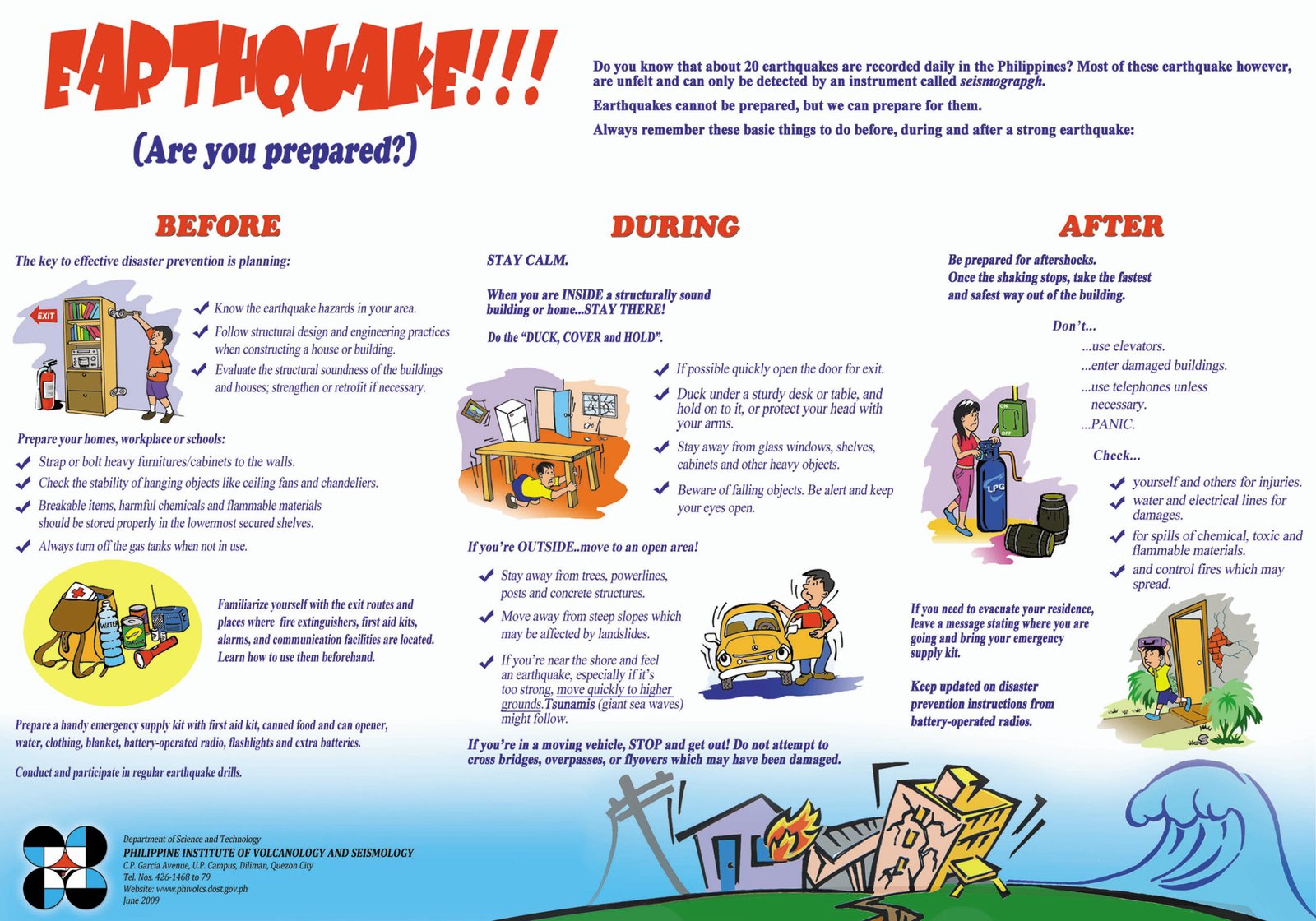


Earthquakes in Albay Province are primarily influenced by the region’s active tectonic setting and volcanic activity, particularly Mayon Volcano, as monitored by the Philippine Institute of Volcanology and Seismology (PHIVOLCS). The province experiences both tectonic earthquakes, caused by movement along faults and nearby subduction zones, and volcanic earthquakes, which are associated with magma movement and rock fracturing beneath Mayon Volcano. PHIVOLCS regularly records clusters of volcanic earthquakes during periods of increased volcanic unrest, indicating internal volcanic processes rather than major fault movement. While most earthquakes in Albay are generally mild to moderate, strong ground shaking can still pose hazards such as structural damage and landslides, especially in steep and volcanic areas. PHIVOLCS continuously monitors seismic activity in the province and issues earthquake information and safety advisories to help reduce risks to communities.
WHAT IS AN EARTHQUAKE?
An earthquake is a weak to violent shaking of the ground produced by the sudden movement of rock materials below the earth’s surface.
The earthquakes originate in tectonic plate boundary. The focus is point inside the earth where the earthquake started, sometimes called the hypocenter, and the point on the surface of the earth directly above the focus is called the epicenter.
There are two ways by which we can measure the strength of an earthquake: magnitude and intensity. Magnitude is proportional to the energy released by an earthquake at the focus. It is calculated from earthquakes recorded by an instrument called seismograph. It is represented by Arabic Numbers (e.g. 4.8, 9.0). Intensity on the other hand, is the strength of an earthquake as perceived and felt by people in a certain locality. It is a numerical rating based on the relative effects to people, objects, environment, and structures in the surrounding. The intensity is generally higher near the epicenter. It is represented by Roman Numerals (e.g. II, IV, IX). In the Philippines, the intensity of an earthquake is determined using the PHIVOLCS Earthquake Intensity Scale (PEIS).
TYPES OF EARTHQUAKE
There are two types of earthquakes: tectonic and volcanic earthquakes. Tectonic earthquakes are produced by sudden movement along faults and plate boundaries. Earthquakes induced by rising lava or magma beneath active volcanoes is called volcanic earthquakes.
EARTHQUAKE MONITORING SYSTEM
PHIVOLCS operates seismic monitoring stations all over the Philippines. These stations are equipped with seismometers that detect and record earthquakes. Data is sent to the PHIVOLCS Data Receiving Center (DRC) to determine earthquake parameters such as magnitude, depth of focus and epicenter. Together with reported felt intensities in the area (if any), earthquake information is released once these data are determined.
EARTHQUAKE PREPAREDNESS
SOURCE: PHIVOLCS